

 8:30 a.m. - 4:30 p.m. M-F

Welcome to Josephine, TX, where every newcomer is a cherished addition to our vibrant community! As you step into our town, you’ll be greeted by the beauty of wide-open spaces and the warmth of friendly faces.
From our annual festivals celebrating local culture to the vibrant community spirit, Josephine offers a unique blend of tradition and modernity. Whether you’re seeking a peaceful retreat or an active involvement in community life, you’ll find endless opportunities to connect and thrive.
As you embark on this new chapter in Josephine, know that you’re not just finding a place to live, but a place to belong. We’re excited to welcome you with open arms and look forward to sharing in the journey ahead. Welcome home!
- Josephine Utility Services
The City of Josephine receives its water from North Texas Municipal Water District.
New residents can set up their account for water, sewer, and trash here.
- Trash
The City of Josephine partners with Republic Services to provide weekly trash pickup. Trash billing is managed by the City, and residents can apply for this service through their utility application. Service begins automatically when new residents request water and sewer services.
If you have any questions regarding trash services or need additional carts, or if you wish to have a cart removed, please contact Republic Services directly at 844.737.8254.
For residents moving into a brand-new home without a trash cart, the Utility Department will automatically order one trash cart for you upon receiving your utility application (unless the Utility Billing Department is notified of additional carts to be delivered). Please note that delivery of new trash carts may take 2-3 weeks.
Josephine does not currently offer recycling services. If you wish to recycle, you may reach out to any 3rd party of your choice.
Majority of the neighborhoods in Josephine have a Homeowner Association (HOA). HOA management companies often maintain these associations for their residents. Each HOA has different sets of rules and governances. Below is a list of the neighborhoods and if available, links to the HOA website are provided.
- Magnolia Pointe
- Fountain View - South
- Fountain View - North
- Waverly Estates
- Riverfield
Community Independent School District serves the communities of Josephine, Nevada, Lavon, and Copeville.
Please visit CISD website for more information https://www.communityisd.org/
The Collin and Hunt County Tax Office provides Vehicle registrations. As part of your vehicle registration, you are issued a set of general issue license plates. More information about license plates can be found at the Texas Department of Motor Vehicles (TxDMV)
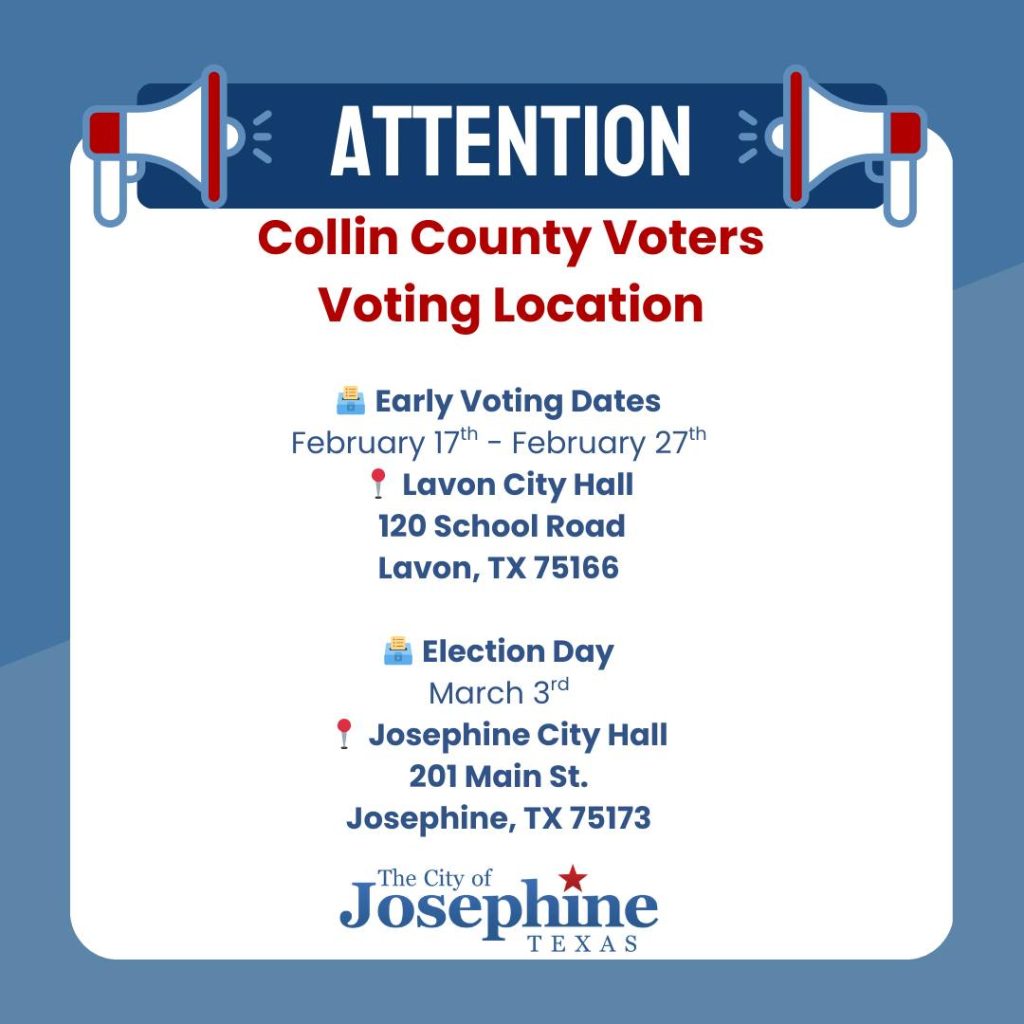
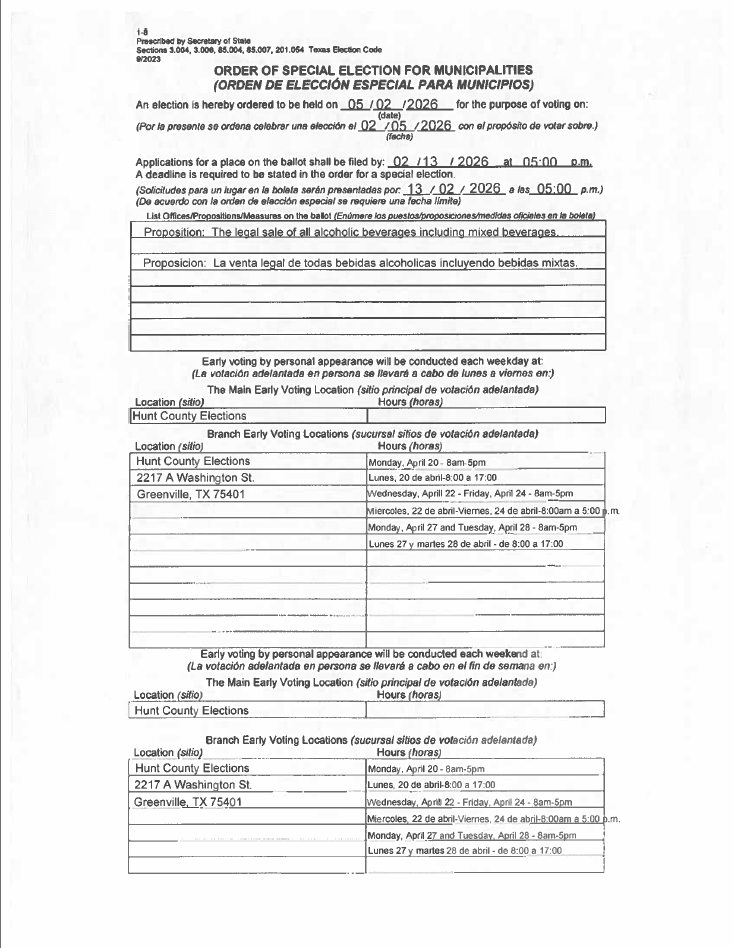
Elections and Voter’s registration is taken care of by Collin or Hunt Country election office depending on the county your residency is located.
Online Registration can be done here: https://teamrv-mvp.sos.texas.gov/MVP/mvp.do
Click Here to view nearby passport services
Municipal Utility District (MUD)
There are several Municipal Utility Districts (MUDs) that are not located within the Josephine city limits but are located within Josephine Extraterritorial Jurisdiction (ETJ). The City does not collect property tax from MUD residents. However, as the MUDs were created, the City of Josephine and the Developer entered into Development Agreements to arrange for the City of Josephine to provide public safety and utility services. The development agreements also provide for the City of Josephine to issue any building permits. While the Josephine Police Department will respond to calls within the MUDs and provide routine patrol services, the City of Josephine is unable to enforce City ordinances beyond city limits. MUD residents receive utility bills from the City of Josephine for public safety services, water, sewer, and trash collection to cover the cost of provided services.
While MUD residents are not officially Josephine residents, the post office allows residents to list Josephine as their city address, but residents must use their assigned zip code. There are several zip codes in the Josephine area and sometimes this causes confusion for new residents about services, school districts, voting centers and delivery services.
A Municipal Utility District (MUD) is a political entity that can levy taxes. A MUD is an alternative financing method that developers often utilize that ultimately creates an independent, limited government authorized to issue bonds and levy taxes for utility and other infrastructure.
Most MUDs are created under the authority of the Texas Commission of Environmental Quality (TCEQ) while some are created by the Texas State Legislature.
MUDs are typically created in areas where land is undeveloped and without infrastructure such as water, sewer, and streets.
MUDs enable developers to pay for vital infrastructure needed to serve a community such as water, sewer, drainage, roadwork, landscaping, and related services.
MUDs are regulated by the state and an election is required to issue bonds to pay for infrastructure. While an election is required to issue bonds for debt that future MUD residents will repay over time in the form of a MUD tax, typically the initial bond election will only have one voter living in the district who votes to issue the debt needed to fund the infrastructure needed to create the development.
MUDs exist separately and out of the control of a city or county government. Cities do have authority for plat approval when a MUD is within a city’s EJT, but cities cannot control elements of zoning such as housing density.
A MUD tax is based on the value of the home. In addition to paying a MUD tax, MUD residents also pay county, school district and any college, hospital or other taxes for their jurisdictions.
Each established MUD has a MUD Board. MUD Board Meetings are open to the public.
The City of Josephine encourages MUD residents to engage with their individual subdivision HOAs and MUD Boards and follow City of Josephine news and events to stay well informed on area happenings.
Magnolia Point MUD
Magnolia Phases 1-10 total of 1,918 lots
Waverly Phases 1-4 total of 784 lots
For Additional information on Magnolia Pointe MUD, please visit the Magnolia Pointe website
Riverfield MUD
Riverfield Phases 1-4 total of 821 lots
For Additional information about Riverfield MUD, please visit the MUD website:
Wildflower MUD
3,300 Homes to be developed
Election for debt issuance held 2024
No homes built yet
Hunt Co. MUD No. 3
Election for debt issuance held 2024
No homes built yet
Golden Barn MUD
No activity yet
Attention Magnolia, Waverly, and Riverfield residents: If you need to file a warranty claim for your home, simply scan the QR code for fast and easy access to all the necessary information. Click Here





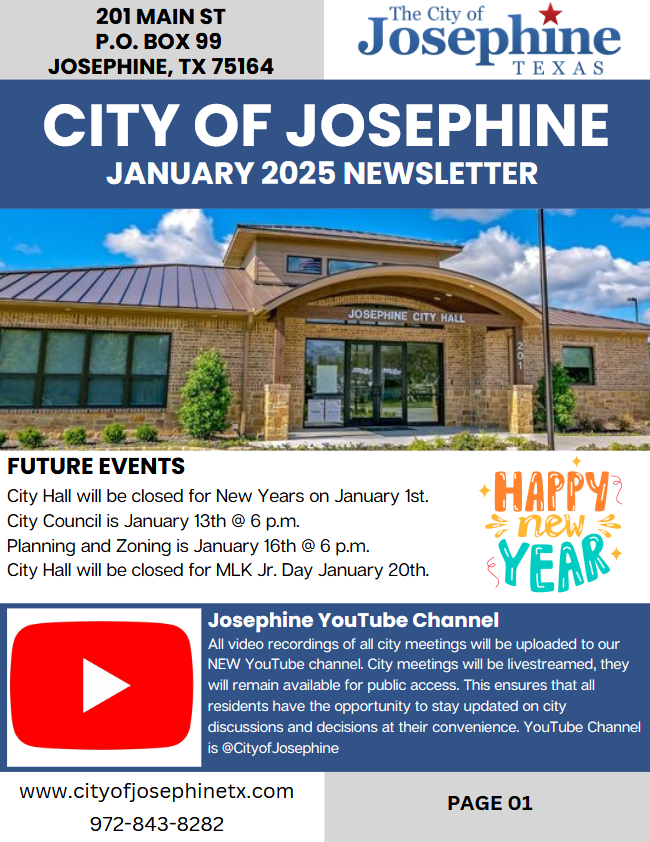
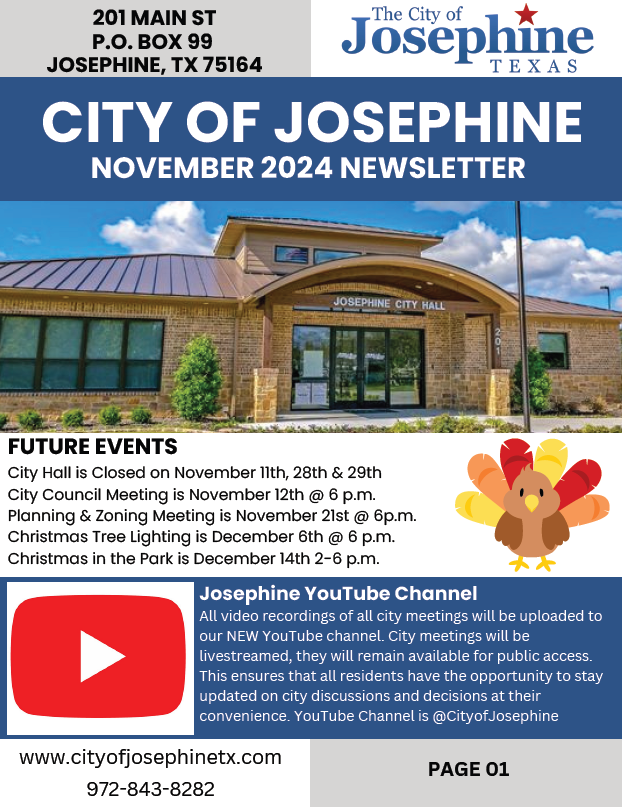
Monthly Newsletter
































City News






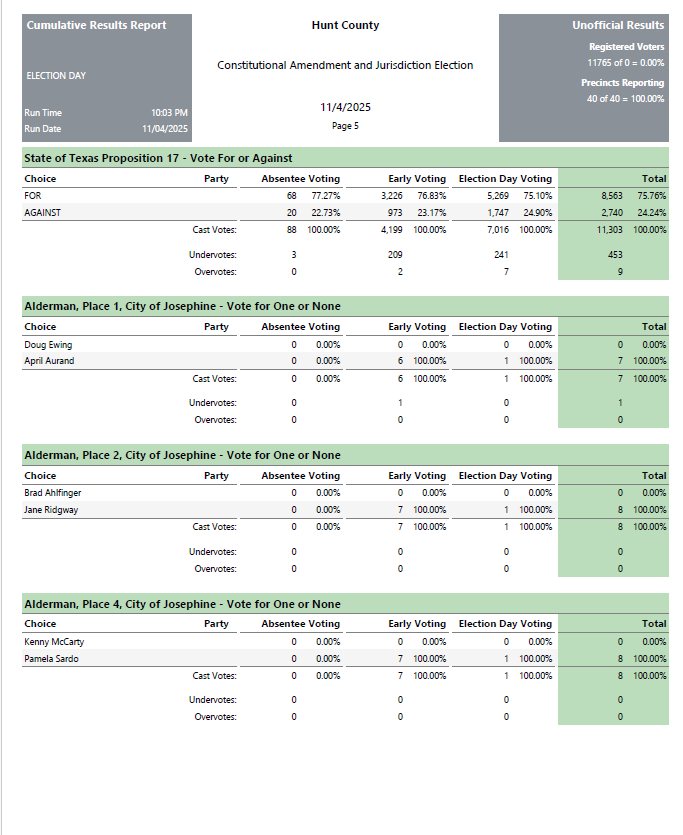














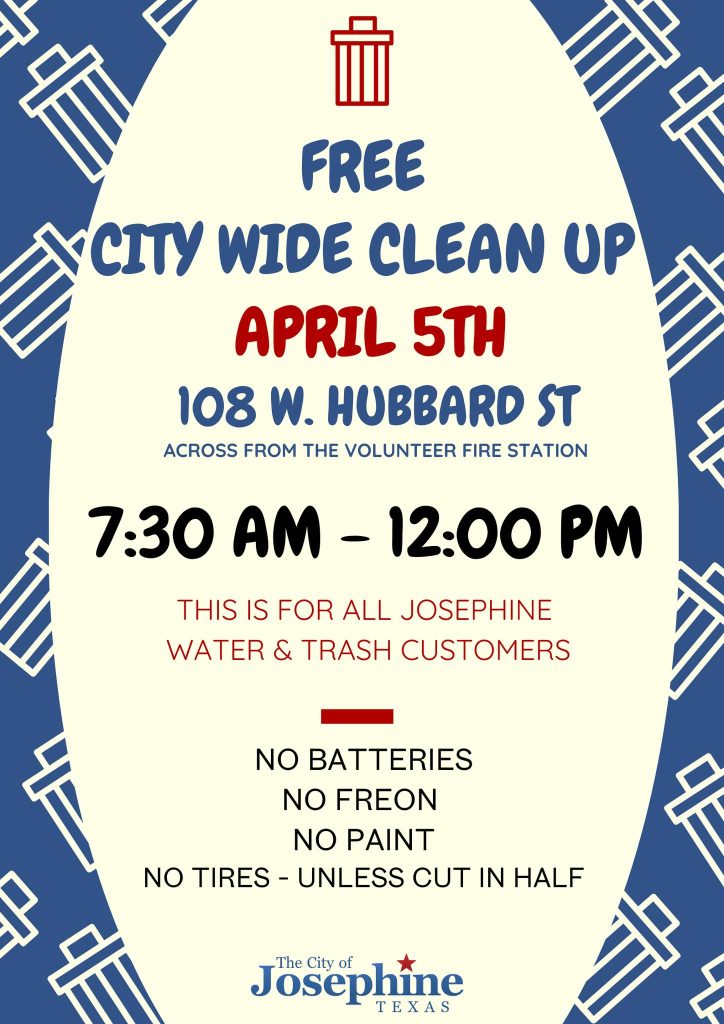









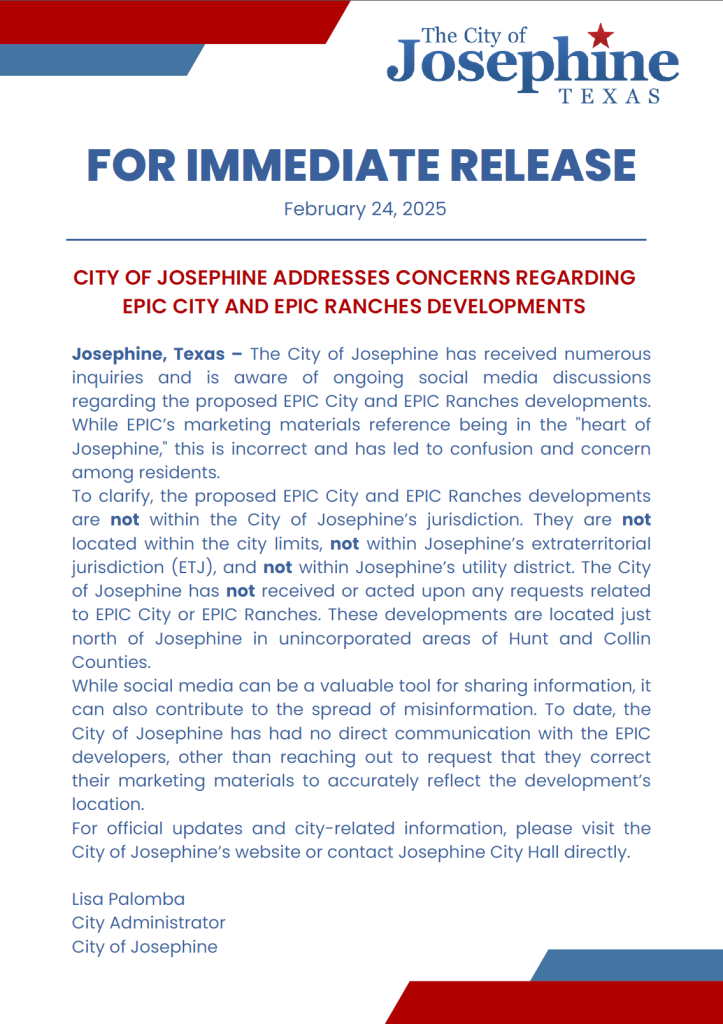



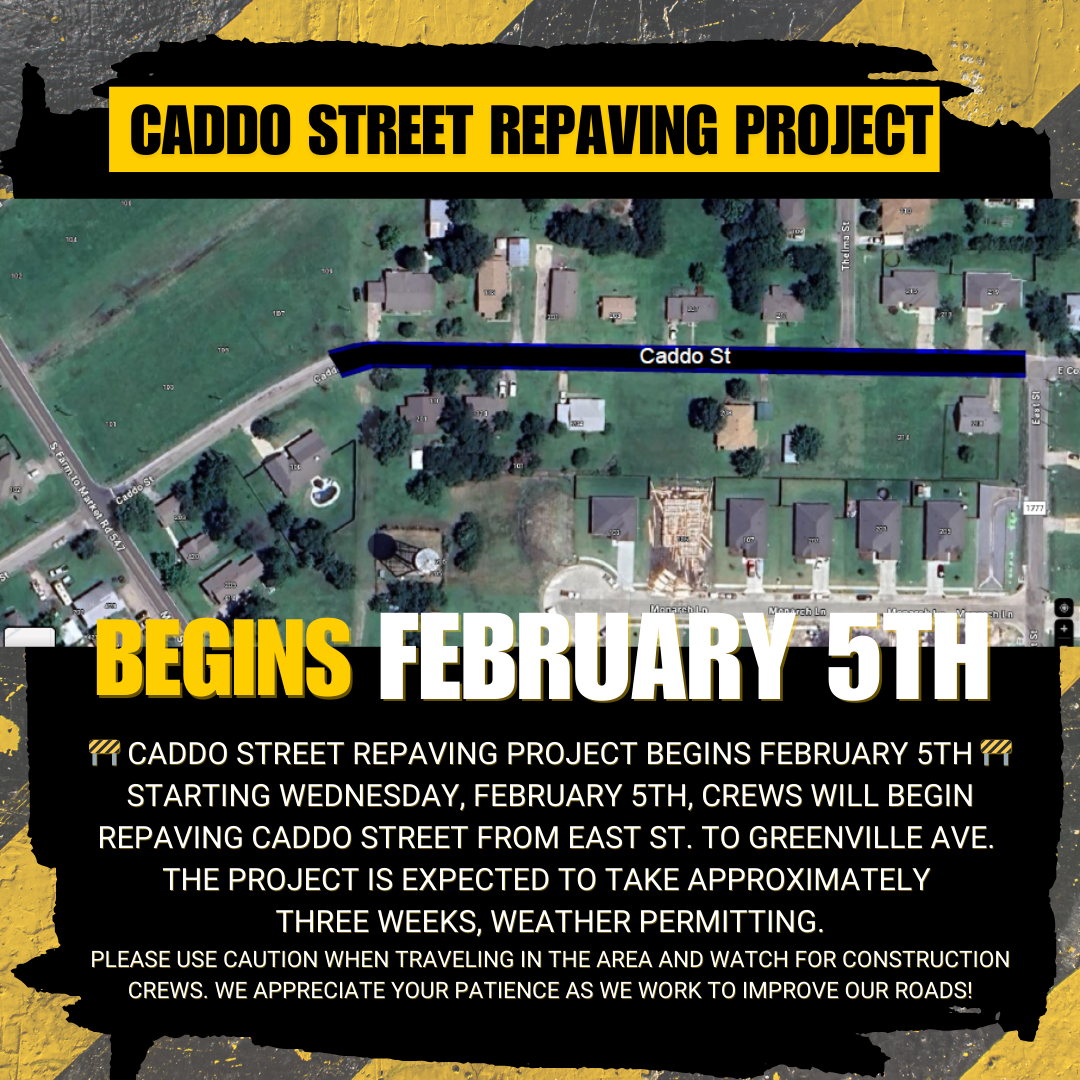

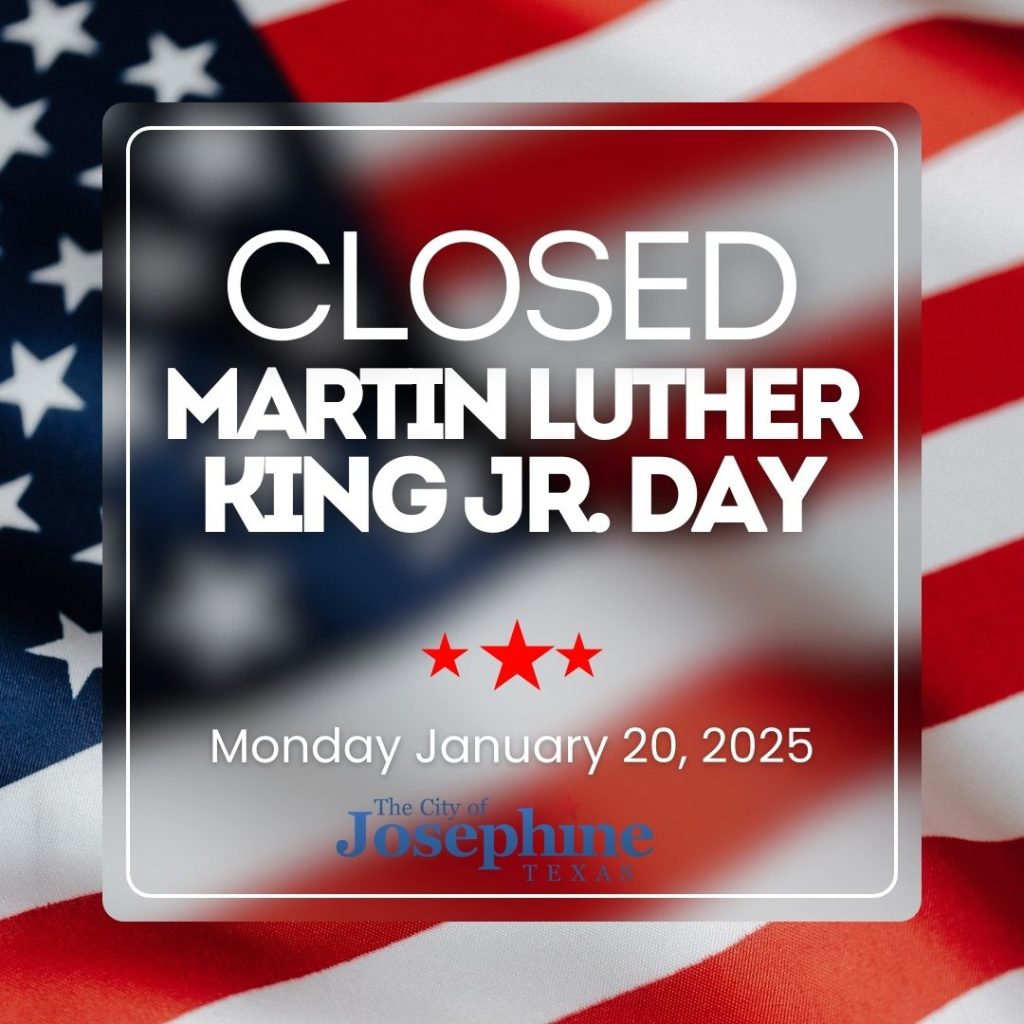









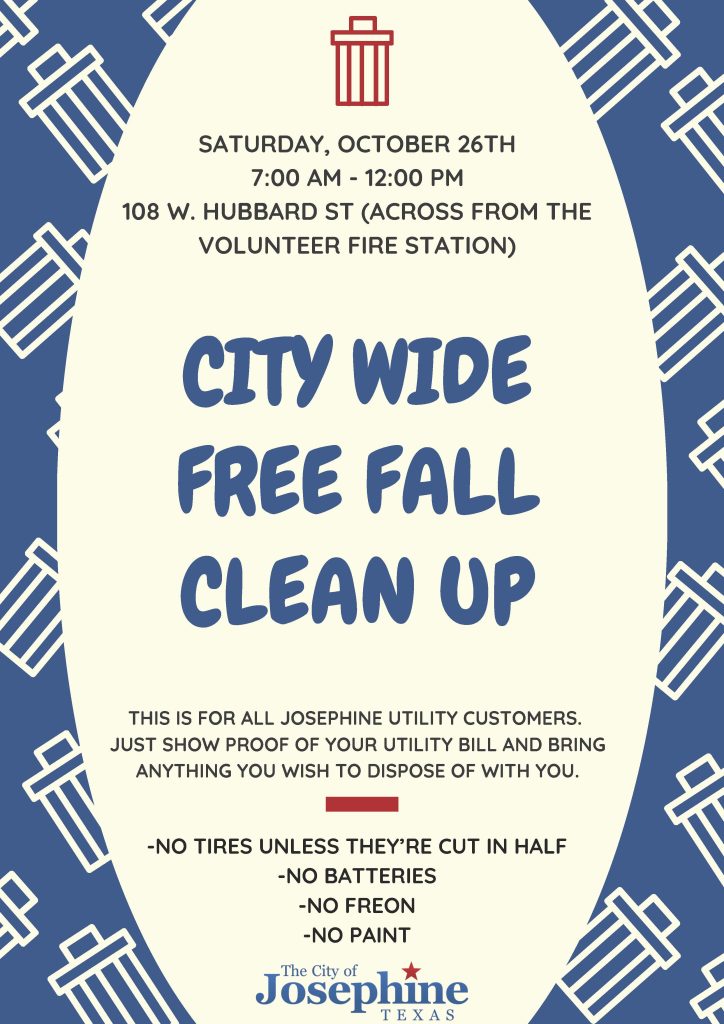




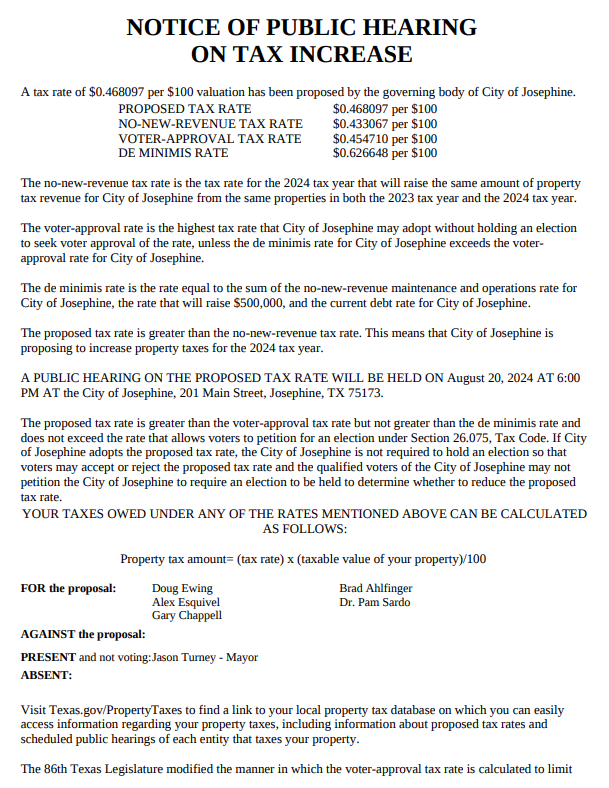
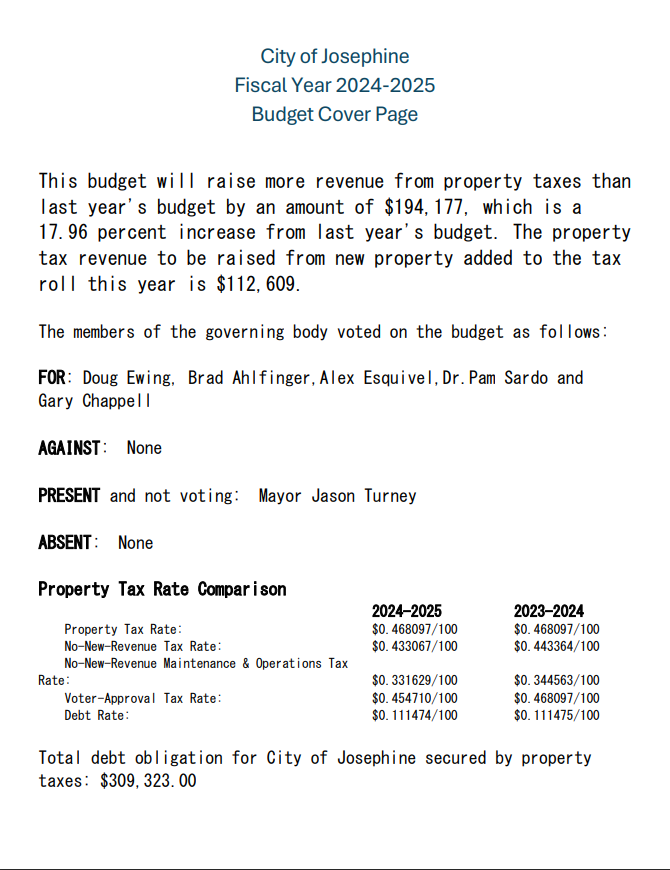







The City of Josephine has two free events every year. We would love to see you at the next one!
Fireworks in The Park – The Saturday before the 4th of July starting at 4pm
Christmas in The Park – The 2nd Saturday in December @ 2-6pm
Vendors – Food Trucks – FREE Carnival Rides – Animals – Great People
The Transparency Center is designed to provide residents with easy access to important information and resources. Here, you can find TCEQ notices received by the City, adopted development agreements, and additional materials such as community surveys, the Comprehensive Plan, and other helpful links. This section will continue to grow as we add more resources to support open government and keep our community informed.
Click here to view the dashboard with available information.
The City of Josephine is proud to offer the Hometown Hero Banner Program, which gives the community the opportunity to recognize and honor Josephine residents and their immediate family members who are serving, have served, or have given their life in service to the United States Armed Forces.
Learn about all our past Hometown Heroes here.
Now offering a free option, please CLICK HERE. This option does not include a banner being hung however it does allow for your hero to be included in our ongoing database to celebrate local heroes who have served diligently in our military forces.
- Banner Fee: Banner Fee: $75 per banner. The fee may vary depending on available sponsorship funds. Payment is due after your application has been approved.
- Application Periods: March 24 – April 19 & September 24 – October 15
- Eligibility: Anyone who pays a Josephine utility bill may apply.
- Application Link: CLICK HERE
To be eligible, an individual must be currently serving in the U.S. Armed Forces (Army, Navy, Air Force, Marines, or Coast Guard); OR be a veteran who was honorably discharged or gave their life in service. The individual must also be, or have been, a permanent resident of Josephine at some point, or have a close family member (spouse, parent, grandparent, child, or sibling) currently paying a Utility Bill for Josephine. City of Josephine employees are eligible to apply for this program regardless of residency.
Applications will be reviewed on a first-come, first-serve basis by city staff. The program is accepting 10 banner applications. Banners featuring the faces of Josephine's military Hometown Heroes will be displayed on light poles in Josephine.
Applications will be accepted from March 24 – April 19 & September 24 – October 15..
In order for an application to be considered complete and fully processed, all supporting documentation must be received and verified by the City, including payment, by the last day applications are accepted. Payment should be made once all other required items have been received and approved. Payment must be received by the final day of the application period. Proof of eligibility will be required before an application is considered complete.
Applicants must submit:
- A screenshot/copy of a utility bill or driver's license/ID with a Josephine address.
- An official military headshot of the person to be honored (minimum 8x10 or 300 dpi digital photo).
- If a high-resolution photo is not available, please bring the hard copy photo to City Hall (201 Main St., Josephine, TX). Digital photos in JPEG, PNG, or TIF format may be emailed to pr@cityofjosephinetx.com. Any original photos or flash drives will be returned to the applicant once banners are complete. Applications will not be processed if a high-resolution photo is not provided.
- Verification of military status (DD214). If still serving, visit the Department of Defense website (https://scra.dmdc.osd.mil/scra/#/home) and submit a copy of the verification page with your application.
Please note that payment is not requested until after the application has been approved.
- Hometown Hero banners are funded by program fees.
- All payments will be made payable to the City of Josephine. The program fee covers banner cost and program maintenance costs.
- Applications may be submitted by individuals or organizations. The applicant will receive a receipt once payment is complete.
There will be a $75 application fee once the application is approved. Payment options are listed below:
Disclaimer: For this year’s Veterans Day 2026 Banner Program no payment will be required. The program is fully funded through a collaborative effort between the City of Josephine and our generous sponsors: AG|CM, Summit LifeGroup, Omniserve Pest Management, Globe Life , Farmers Electric Coop, and Baxter IT Consulting.

- Cash & Check- Cash or Check payments will be accepted in person at the Josephine City Hall during normal business hours (M-F, 8:30AM-4:30PM)
- Credit &Debit Card- Online payment options will be available. There is a processing fee when paying with a card. Click Here to Pay
- A proof of all banners will be sent to applicant for approval prior to printing at the email address provided on the application.
- The information displayed on the banner will include the hero's name, rank, branch of service, and years served. Any additional information to be included on the banner is at the sole discretion of the City.
- The banner program, including installation, is at the sole discretion of the City and is based on the availability of City staff, resources, and staff scheduling for installation and removal.
- At the conclusion of the banner display period, City staff will contact the applicant to arrange banner retrieval. Any banners not claimed within sixty (60) days will be mailed or hand-delivered to the address provided on the application.
- Banners displayed as part of the Hometown Heroes Banner Program will remain on display for a period of approximately six (6) months.
- Banners will be placed by City staff along the specified route. Banner placement is not selected by the applicant.
- The City of Josephine is not responsible for replacing banners; this includes banners that are stolen, damaged, or destroyed due to age, vandalism, or any acts of nature including high winds.
- Any loss or damage to an installed banner will be handled at the discretion of the City.
- The City may choose to not install a banner if the requirements of this banner program are not met.
- The City of Josephine reserves the irrevocable right to use the photograph/image/likeness in all forms and manner, and edit, use, reproduce, exhibit and distribute this photograph in whole or in part, in any manner and media now known or hereinafter invented, including, but not limited to, print, publications, the City website, banners, and social media, in perpetuity throughout the world, in support of and/or to promote the City of Josephine programs, services and mission, and for archival purposes.
If you have questions regarding the Hometown Hero Banner Program, please email pr@cityofjosephinetx.com.
📍 Location
Josephine Community Center
404 Main St. Josephine TX 75173
🕒 Rental Operating Hours
Open Daily* | 7:00 AM – 11:00 PM
*Open to the public every Tuesday and Thursday from 10:00 A.M. – 2:00 P.M.
- Review and Complete the Policy Form
Please visit MyGov Collaboration Portal to start your application. If this is your first time utilizing MyGov you will need to become a collaborator before applying. Complete the Community Center Policy Form and submit it to the City of Josephine for review. - Confirmation & Availability
Before starting an application, please contact the City of Josephine to confirm the date you are wanting to book is available.
Please Contact: 469-717-9054
Please note that checking availability does not secure your reservation. Your reservation will not be secured until the application is submitted, and you $150 deposit is paid. - Non-Profit Use
If you are a Josephine-based non-profit using one of your 12 free bookings per year, please include a copy of your 501(c)(3) tax-exempt form with your request. - Securing Your Reservation
Once the City of Josephine has confirmed that your requested date is available, you will be instructed to complete the required steps to secure your reservation.
A $150 deposit is required to secure your Community Center reservation.
The deposit should only be paid after the City of Josephine has confirmed that your requested date is available.
Your rental date is not secured until the application and $150 deposit have been received. Until these requirements are completed, the date remains available for others to reserve. - Key Pickup & Deposit
Once your reservation has been accepted, the City of Josephine will invoice you for the applicable rental fees through MyGov. You will receive an email notification when your invoice has been sent.
All rental fees are due at least 24 business hours prior to your scheduled event.
You may pick up the Community Center key 24 business hours prior to your event. - Deposit Refund
The deposit refund process begins once the Community Center key has been returned to City Hall along with a completed cleaning checklist.
Pending no damages or violations of the rental agreement, your deposit will be refunded within seven business days. You may have it mailed to you or request to pick up your check when it is ready.- Pending no damages or violations of the rental agreement, your deposit will be refunded within seven business days.
- You may have it mailed to you or request to pick up your check when it is ready.
We welcome residents, organizations, and neighbors to utilize this space for events, meetings, and special gatherings. Here’s how the fees break down:
- Josephine Utility Customers:
$50 per 4 hours (Monday – Thursday)
$75 per 4 hours (Friday-Sunday)
Each additional hour is $12.50 - Non-Josephine Utility Customers:
$150 per 4 hours (Each additional hour is $37.50) - Josephine Non-Profits:
12 free events per calendar year - Josephine Homeowners Associations (HOAs):
$75 per meeting
Join us every Tuesday and Thursday from 10 AM – 2 PM at the Community Center! Whether you’re looking for a cozy spot to enjoy some coffee, play card games, challenge a neighbor to Jumbo Connect Four, or just catch up with friends — this is your space to relax and connect. ☕🃏🎲
We kindly ask that children under 14 are supervised by an adult. Come celebrate community with us — we can’t wait to see you!
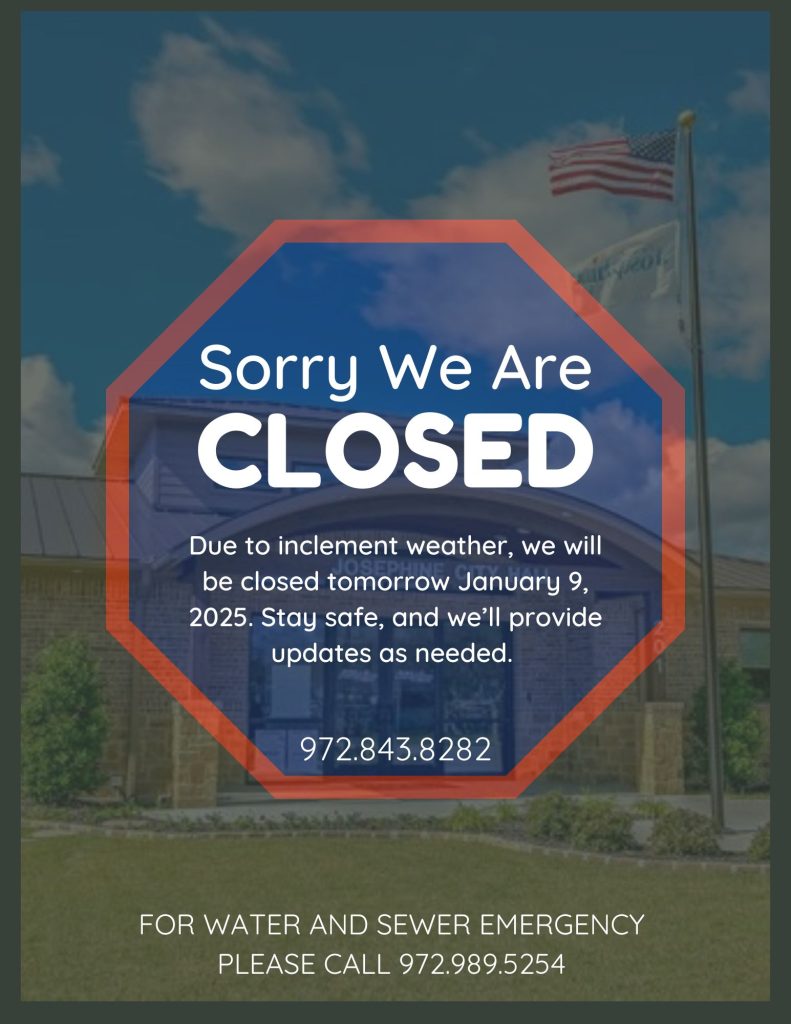
*If City Hall is closed for bad weather or a scheduled holiday, the Community Center will be closed too.*
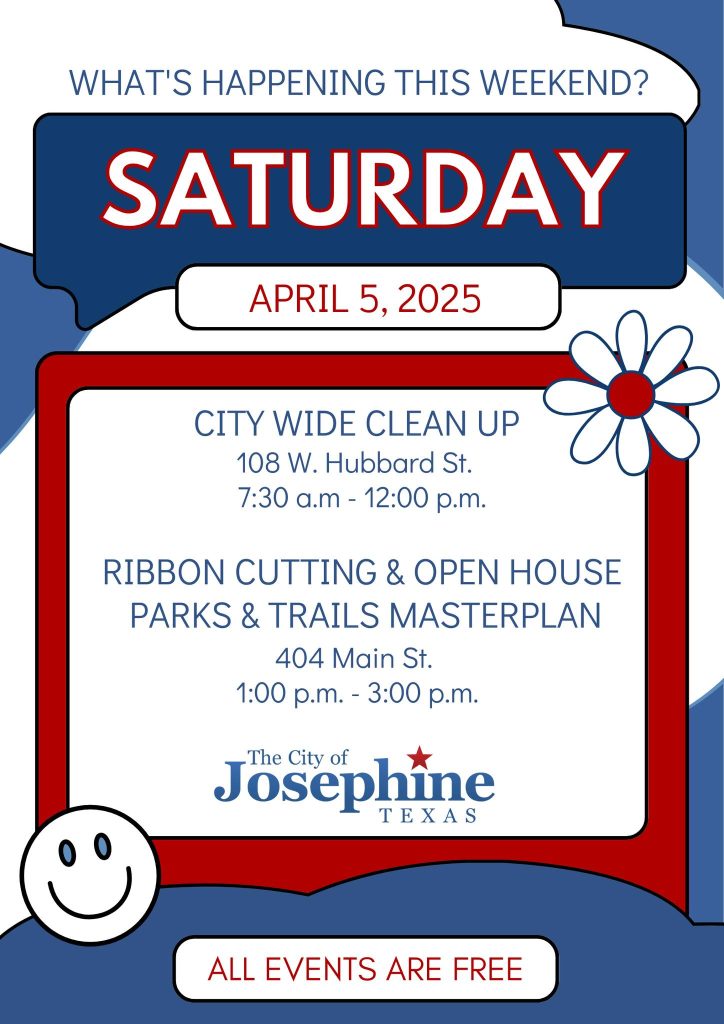
April 5, 2025
We’re thrilled to announce the grand opening of the first-ever Josephine Community Center!
This beautiful space—originally a historic church—has been lovingly restored to serve our growing community. With a blend of timeless charm and modern functionality, the Community Center is now a vibrant place for collaboration, celebration, and connection. It stands as a proud symbol of our city’s progress and our shared vision of an engaged, united Josephine.
Josephine Community Center Amenities
Our Community Center is the perfect space for your next gathering, event, or celebration! Here’s what we offer:
🎉 Amenities Include:
- Warming kitchen for easy food prep
- Coffee airpots for serving large groups
- Two TVs and a projector for presentations or entertainment
- Podium for speakers and announcements. (Microphone not included)
- Circular tables and chairs provided
- Refrigerator and ice machine
🏛️ Capacity: Up to 175 guests
🚗 Parking: 38 dedicated parking spaces
Book your event today and enjoy a welcoming space with all the essentials!

Contact Us
Office

Hours
 8:30 a.m. - 4:30 p.m. M-F
Mailing Address
 City of Josephine PO Box 99 Josephine, TX 75164
Quick Links
Josephine is a fast-growing community located just east of the DFW Metroplex, home to A-rated schools and a small-town, country atmosphere.



Frequently Asked Questions
Josephine is a fast-growing community located just east of DFW Metroplex, home to A-rated schools and a small-town, country atmosphere.
- - Click Pay Water Bill
- - Click Sign in or Sign up
- - Click Register
- - Enter the email and password you would like to use for your login
- - It will send you an email to the email address you provided to verify the email address.
- - Go to the email it sent you and activate /verify your email
- - Login to the portal with the email address and password you signed up with
- - Click on Add to my service under additional links
- - Click on Utility Billing
- - Click on add account
- - Enter the account number including the dashes
- - Enter you last payment amount excluding the dollar sign. If you have not made a payment you will need to put zero.
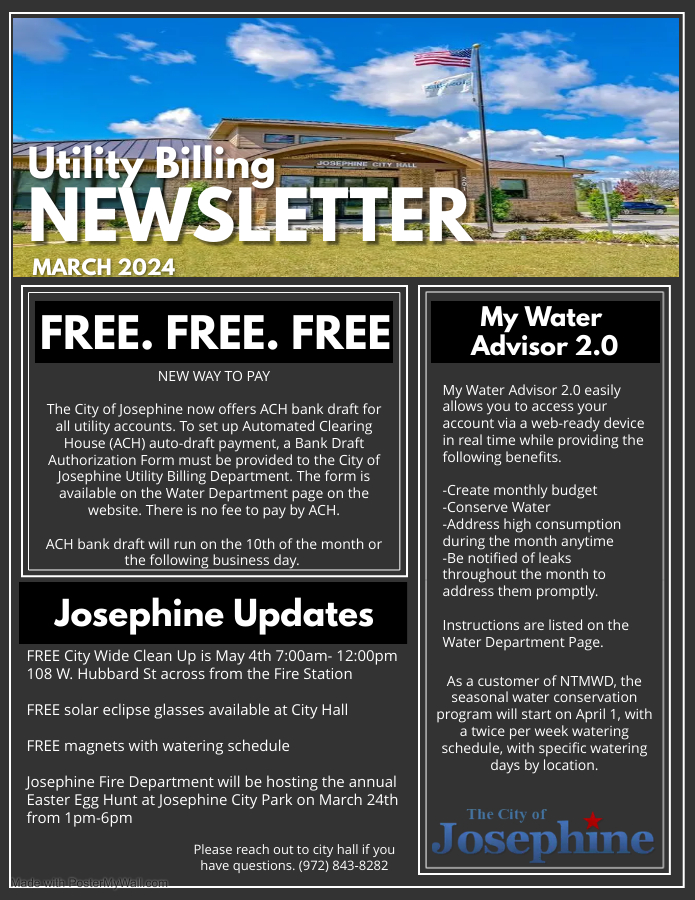
Utility bills are available by the 1st on the portal every month and are due by the 15th every month. A $20 late charge is added the following business day if not paid in full. If the 15th falls on a weekend or holiday you will have until the following business day at 8 a.m. to submit a payment. Your water meter is read the week of the 20th of each month. Any unpaid balance not paid in full by the 25th of the month will result in disconnection of service the following business day.
- Online Portal
- You will need your account number and last payment amount
- This is where you can sign up for auto pay
- Call the secure phone line to pay (877) 881-0113
- You will need your account number and service address
- Cash, check, or money order to avoid processing fees
- You can utilize bill pay through your bank if your bank has that capability. Utilizing bill pay can take up to 2-3 business days for the city to receive payment.
- You may utilize the city drop box located at City Hall 201 Main Street
- ACH Bank Draft
- Your utility bill will be drafted on the 10th of each month or the following business day if the 10th is a weekend or holiday. This is a FREE way to pay. You must complete the bank draft authorization form on the water department page.
Call City Hall if the issue is between 8:30-4:30pm Monday - Friday. Call the emergency after hours line if it any other time.
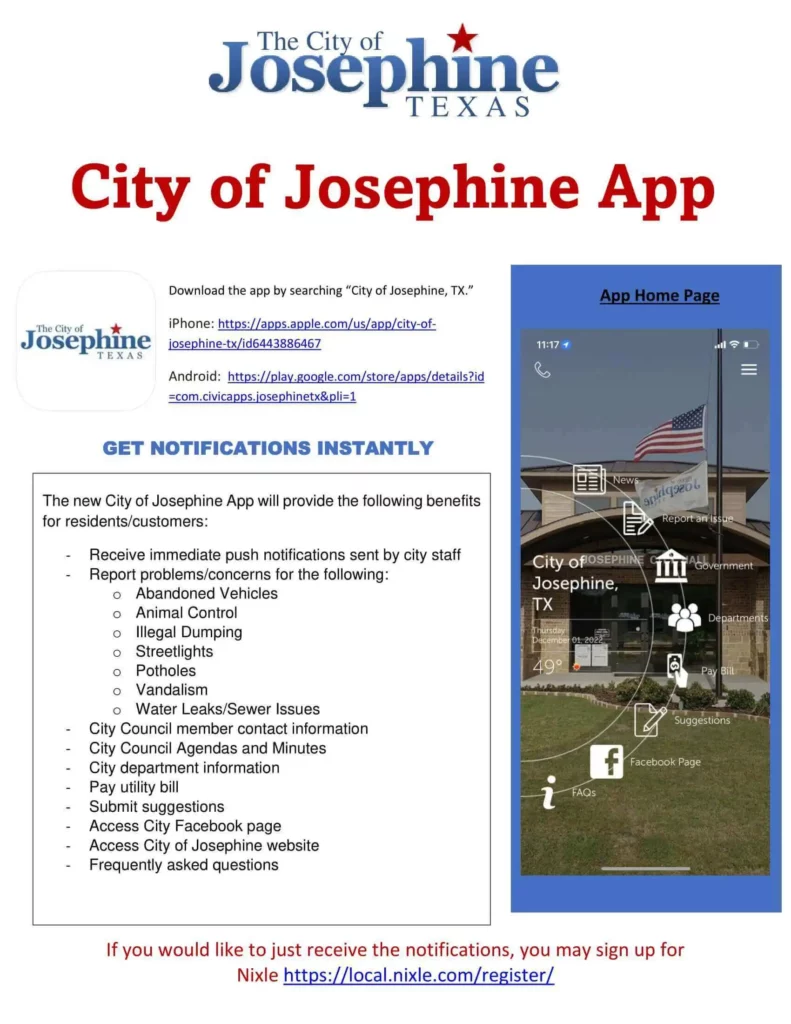
Sign Up For Alerts
Sign up to receive messages from City of Josephine! (nixle.com)