

Backflow Testing Program
Providing safe drinking water to Josephine is our highest priority.
Regulated by Texas Commission on Environmental Quality (TCEQ) and the U.S. Environmental Protection Agency (EPA), NBU follows strict standards to ensure that the public drinking water supply remains safe.
Our customers also have a responsibility to help keep the public water supply safe. If a source of water exists on your property, like an irrigation system or a pool, the possibility for contamination is there.
Backflow preventers are required to prevent contamination whenever there is an actual or potential hazard for a cross-connection to ensure your and the community’s water supply remains safe.
- Residential must be tested upon installation and at least every 3 years. Additional testing may be required depending on the health hazard.
- Commercial must be tested upon installation and at least once annually. Additional testing may be required depending on the health hazard.
As part of the City of Josephine Cross Connection Control Program, the City has partnered with SC Tracking Solutions, LLC (SCTS) to provide an online catalog and tracking tool for annual water service Backflow Prevention Assembly and Customer Service Inspection reports for commercial businesses, residential properties and educational facilities. This new web-based format and local ordinance will simplify current processes and help ensure that inspections are performed in accordance with local ordinances and Texas Commission on Environmental Quality (TCEQ) regulations [30 TAC 290.44 (h) ( 4)].
To ensure that your assembly remains in compliance with state and City of Josephine ordinance, please contact a TCEQ licensed Backflow Prevention Assembly Tester (BPAT) by the Due Date listed below to have the appropriate assemblies tested. For a list of TCEQ licensed BPATs, contact SC Tracking Solutions at (866) 232-0174 or visit the website https://www.sctrackingsolutions.com/ and click “Need a Service Provider?”
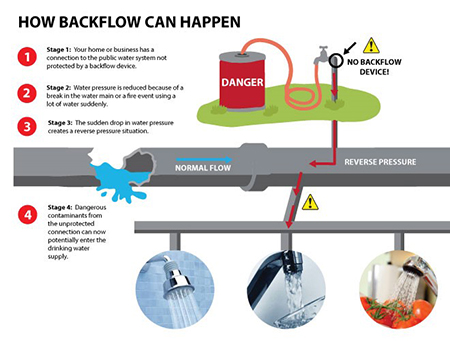
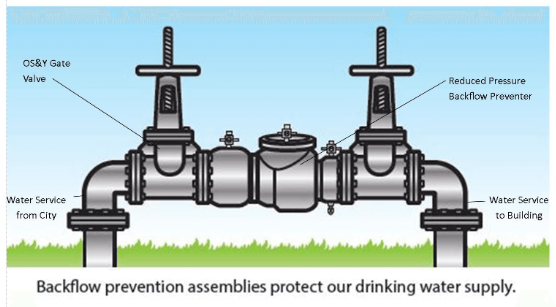
Here is an explanation video of the importance of Backflow. https://youtu.be/FpBt5-pqtfY?si=9XoTkisJ3CPa3Pdc
City Ordinance
Testing of assemblies.
(1) All required backflow assemblies shall be tested upon installation or failure by a recognized backflow prevention assembly tester, and certified to be operating within specifications. Backflow prevention assemblies which are installed at Commercial locations shall be tested annually. Backflow prevention assemblies which are installed at Residential (single family) locations shall be tested every 3 years. All health hazard backflow prevention assemblies shall be inspected and tested or caused to be inspected and tested by the City in each of the following circumstances:
(i) Immediately after installation;
(ii) A minimum of once a year or as required by the managing director;
(iii) Immediately after repair;
(iv) Premises that have been vacated and unoccupied for one year, prior to re-occupancy;
(v) Whenever the assembly is moved.
(3) All assembly testing shall be performed by a state licensed backflow prevention assembly tester, approved by the City.
Frequently Asked Questions
The program safeguards our public drinking water and protects the health of our customers by ensuring that any contaminants that could backflow into the public water supply system are isolated within the customer's internal distribution system.
Backflow refers to the reverse flow of non-potable water, or other substances, into the piping of a public water system or customer's potable water system. Two types of backflow are backpressure and back-siphonage.
A backflow prevention assembly is a means or mechanism to prevent backflow. The basic means for preventing backflow is an air gap, which provides a barrier from backflow. The principal types of backflow prevention assemblies are reduced-pressure, pressure vacuum breaker and double check valve.
Mechanical backflow prevention assemblies have internal seals, springs, and moving parts that are subject to fouling, wear and fatigue. Also, backflow preventers and air gaps can be bypassed. Therefore, all backflow prevention assemblies have to be tested to ensure that they are functioning correctly. All assemblies have to be tested with properly calibrated gauge equipment.
The program safeguards our public drinking water and protects the health of our customers by ensuring that any contaminants that could backflow into the public water supply system are isolated within the customer's internal distribution system.
Backflow refers to the reverse flow of non-potable water, or other substances, into the piping of a public water system or customer's potable water system. Two types of backflow are backpressure and back-siphonage.
A backflow prevention assembly is a means or mechanism to prevent backflow. The basic means for preventing backflow is an air gap, which provides a barrier from backflow. The principal types of backflow prevention assemblies are reduced-pressure, pressure vacuum breaker and double check valve.
Mechanical backflow prevention assemblies have internal seals, springs, and moving parts that are subject to fouling, wear and fatigue. Also, backflow preventers and air gaps can be bypassed. Therefore, all backflow prevention assemblies have to be tested to ensure that they are functioning correctly. All assemblies have to be tested with properly calibrated gauge equipment.
If you have any questions or concerns, please call 972-843-8282.
The City Street Department maintains 27 miles of streets within the Josephine city limits.
Services
- Pothole patching
- Major street patching, milling, grinding, and/or level lifting of the pavement to eliminate standing water
- Fallen tree removal
- Shoulder maintenance
- Severe weather response
- Concrete alley/street repair/reconstruction
- Asphalt street rehabilitation
The Street Division is responsible for the repair and maintenance of the street, alley and storm sewer systems in The City of Josephine. In addition to maintenance services, the division is responsible for the minor construction in cases involving alley, curb and street failures.
The division also maintains the structural integrity of screening walls and removes debris and obstructions from the upstream sides of all bridges and culverts to eliminate any restrictions to storm-water flow.
The division also removes trees from streets and alleys and sands the streets due to inclement weather.
Please note that streetlight repairs are handled by Oncor and not by the City of Josephine. More information is available here. MUD residents (Magnolia Pointe, Waverly Estates, and Riverfield) please report outages directly to your HOA.
Water turn on and reinstates are non-emergency and will not be dispatched after hours. Customers can only be connected Monday-Friday 8:30am to 4:30pm.
Water emergencies include but are not limited to main water breaks. Sitting water in the meter box and minor leaks are considered Non-Emergency and will be handled during normal business hours.
Contact Utility Billing for questions regarding utility bill and payment, meter sets and fee, and utility tap fees. Phone: 972-843-8282. Email: water@cityofjosephinetx.com
| Document Name | Download |
|---|---|
| 2024 CCR report | |
| 2023 CCR Report | |
| 2022 Consumer Confidence Report | |
| 2021 CCR Water Report | |
| Water System Map |
Water FAQs
An in-ground enclosure that is made to protect the meter. It is normally located near the curb or property line. It will have either a black or blue lid that houses shut-off valves, meter, optional check valves, regulators, or pressure reducing valves.
An in-ground enclosure that covers and protects your underground sprinkler system valves and backflow preventer. It is normally located just past the meter box on the other side of the sidewalk with a green lid.
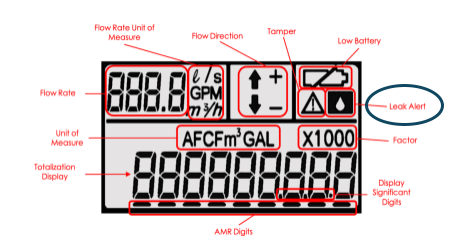
Leak Alert, Tamper, and Low Battery:
These alerts are triggered by measurement from the register and are transmitted back via the Master Meter proprietary protocol.
1. A Leak is triggered after 24 hours of continuous 15-minute periods of NO zero consumption reads.
2. Tamper is triggered when a magnetic field is sensed for more than 1 minute.
3. Low Battery alarm is illuminated once the unit reaches its final 2-6 months of unstable life.
2024 – Water Conservation and Water Resource
Mandatory Outdoor Water Restrictions:
From April 1 through Oct 31:
Limit landscape watering with sprinklers or irrigation systems at each service address to no more than 2 days per week (April 1 – October 31), although less than twice per week is usually adequate. Additional watering of landscape may be provided by hand-held hose with shutoff nozzle, use of dedicated irrigation drip zones, and/or soaker hose provided no runoff occurs. Lawn and landscape watering are limited to twice per week as per the chart: CLICK HERE
Water Conservation Tips
www.watermyyard.org
2015-04-24 FINAL - Regional Game Plan
Water Information and Reports:
Important Notes from North Texas Municipal Water District
Services and/or programs:
- Maintain and repair wastewater collection system piping and lift stations
- Clear stoppages
- Monitor and control lift station run times
- Manhole/mainline inspection, repair, and cleaning
- Perform post-construction camera inspection of new service lines
- Perform preventive maintenance citywide in areas prone to service interruptions
Learn how fats, oils, and grease (FOG) can impact our sanitary sewer system.
| Document Name | Download |
|---|---|
| Sewer System Map |
Wastewater FAQs
Plumbing access to a structure's main sanitary sewer drain piping to allow cleaning entry point when a stoppage occurs.
Depending on where the sewer main is located either out front or behind the structure. The clean-outs will be located in close proximity to the structure. Within a couple feet of the foundation. Usually inside the flower bed.
1). Older structures will have a 4" cast iron pipe with a hub and brass threaded cap.
2). Newer structures can have either a 3" or 4" PVC pipe with a brass cap, PVC cap, or rubber cap.
Rubber Caps - Take the steel band-off cap with a flat-head or common screwdriver.
PVC Caps - Unscrew with a pipe wrench, channel lock, or large crescent wrench.
Brass Caps - Same as the PVC caps. Most brass cap threads will lock into cast iron pipe making it difficult, if not impossible, to remove unless threads were lubricated prior to installation. Sometimes the best and easiest way to remove the brass cap is to bend it slightly enough to drive a flat-head screwdriver into the threads and pop the cap off the clean-out. Do not drive cap into clean-out or drop it down into the clean-out; this will most definitely cause a stoppage.
Most residences have a double clean-out with two clean-out stacks.
1). The stack closest to the foundation sweeps away from the house and toward the city's sewer main.
2). The stack farthest from the foundation sweeps toward the house to allow cleaning under the house.
3). Some residents will have a city clean-out by the road or property line.
Sewer stoppage will be under the house.
Sewer stoppage will be toward the city's sewer main.
To report any problems within the City of Josephine, please download the City of Josephine app and click Report an Issue. Google Play App Store
Types of issues you can report:
- Abandoned Vehicles
- Animal Control
- Illegal Dumping
- Light Poles
- Potholes
- Vandalism
Or email it to water@cityofjosephinetx.com or call 972-843-8282.
CONTACT US

Garrett Jackson
Director of Public Works